
There is no doubt that organizing a landscape or a construction job could be really exciting and challenging. At the same time, it might be difficult to calculate the required quantities of materials. No matter what you want to do, from laying a walkway to making a different type of structure, you need to know accurately how much material will be needed to complete the project successfully. This is when the pea gravel calculator becomes useful.
With the help of this calculator, you can easily and conveniently calculate the required amount of gravel. This way, you save yourself the trouble of over-purchasing and guesswork when it comes to choosing the right amount of materials for your future structure. This article will teach you about pea gravel and how to use the calculator.
What Is Pea Gravel?
The pea gravel consists of small pebbles that are the same size as a pea. The water assists in rounding off these pebbles and polishing them. One can walk on them owing to their polished state. Pea gravel has numerous uses, which is why it is extensively used in households and industries alike. It is commonly used in gardens for making pathways, driveways, patios, and outdoor sitting areas because it can be used in various ways, and it looks beautiful. It is also used in play areas as ground cover because it is slippery. Besides, it is also extensively used in the drainage system since it does not allow the accumulation of water.
What Is a Pea Gravel Calculator?
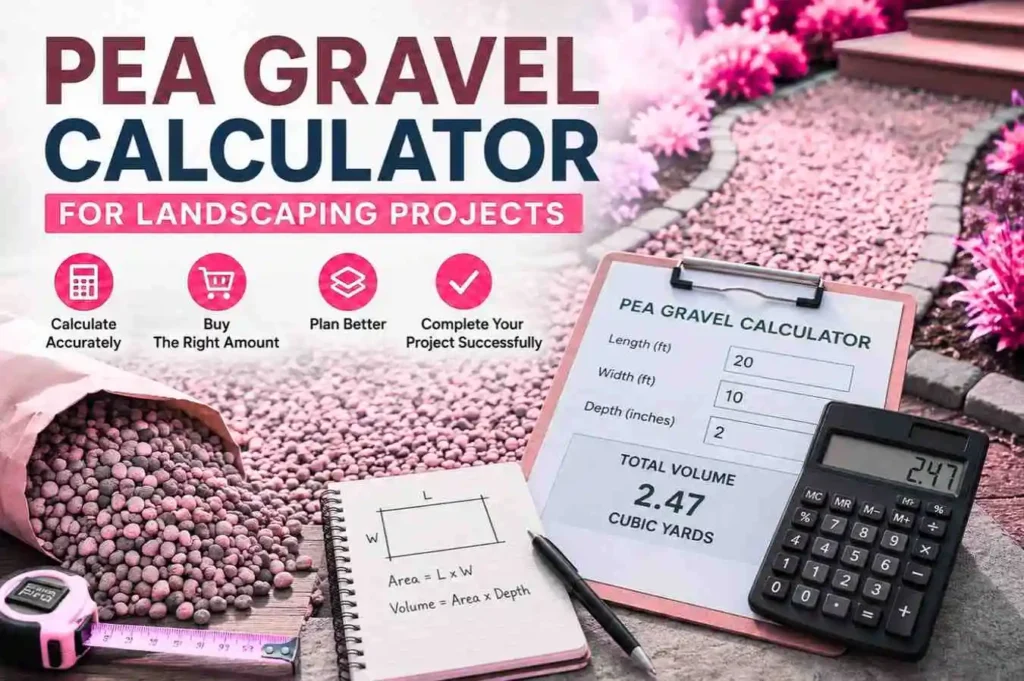
Pea Gravel Estimator is an outstandingly simple-to-use and handy calculator that can quickly and efficiently determine the required amount of gravel for any job according to the size parameters. Due to the calculator, it becomes easy and quick to get the results and even estimate the expenses, making the work much more comfortable to conduct. Using the calculator, it will only be necessary to provide basic information about the surface size (length, width, and depth), without having to spend too much time calculating anything manually. The outcome will be immediately visible: the amount of pea gravel required.
Why Use It?
The pea gravel calculator does not only provide efficiency in terms of speed, but it provides accuracy and preparation as well. By obtaining results instantly, you will not only get things done quickly, but you will be able to avoid wasting any time due to confusion because of mathematical calculations, especially if you do not have any experience with such calculations. One more benefit that you will obtain through the use of the calculator is that there won’t be any waste, since you will purchase exactly the needed amount of gravel, without extra expenses for purchasing more than you actually need.
How It Works
The role of the gravel calculator is to be able to compute the quantity of gravel required for any given area using the basic volume formulae. The volume does not need to be computed manually but rather can be done with the help of the gravel calculator.
1. You Enter Basic Measurements
Your calculations will begin with the use of data from your building site. For the calculations to be successful, you need to give the dimensions of your building site, which include length, width, and depth, which can be determined using the depth of the gravel layer.
2. It Calculates Volume
Below is an example of a calculator that uses a basic formula to determine volume.
Volume = Length x Width x Depth
This is a tool that helps one find the volume of the area to be filled with gravel by multiplying the three measurements of your place. The calculator automatically converts the units of measurement into a uniform standard before calculating anything, as the depth is measured in inches while the others are in feet/meters.
3. Unit Conversion Happens Automatically
After calculating the number, the next step will be converting it to a more useful unit of measure since this will make it easier to use during construction work. In most cases, the unit of measure used here is cubic yards, a very popular measure for purchasing large amounts of gravel. Alternatively, the number of bags needed can be provided in smaller-scale projects.
4. It Applies Gravel Density
Likewise, the density of the pea gravel should also be similar to that of the gravel. The density of the gravel varies from 1.4 to 1.7 metric tons per cubic meter. This information, it will allow us to do various calculations. In particular, we will use the density to measure the amount of the substance in relation to its weight and volume.
5. Optional Cost Estimation
Moreover, there are several calculators that enable you to enter the price of materials in tons, cubic yards, or bags. After entering the required information, the calculator computes the total cost of your project. This will help you manage your budget and eliminate any unforeseen costs.
6. Instant Results
Within just a few seconds, everything that you need to know about your project will be known. With the help of the calculator, you will find the weight/cubic footage of the pea gravel you need, along with its cost.
How to Use It
The steps involved in calculating the amount of pea gravel are straightforward. First, take the measurements (length and width) of the area where the pea gravel will be laid, preferably in feet, since that makes the calculations easier. Determine the depth required for the pea gravel. After noting down all three factors, input them into the calculator to determine the total volume of pea gravel that is required. However, to ensure that there is a sufficient supply of pea gravel, add 5–10 percent more to the volume indicated by the calculator; this is just in case there are problems with waste, uneven areas, or settling of the pea gravel.
Conclusion
When working on any construction or landscape project, you must consider using a pea gravel calculator. First, it eliminates all unnecessary assumptions and ensures that you have accurate measurements for your calculations. It will help you budget and tell you how much material you need. You will find yourself getting accurate figures regardless of whether you are working on a pathway or driveway project. By practicing a bit, you can master the art of calculating measurements and other factors, including wastage and the required depth of material needed. When planning a project soon, ensure that you use this calculator.
FAQ’s
Q1. Can you use pea gravel calculators for bigger jobs as well?
Yes, it can be used for both small and big projects. Be it a garden path or a big driveway, the calculator will help you get accurate and quick calculations.
Q2. Can you use a gravel calculator on something that isn’t straight?
Yes, that is possible. Break the space up into smaller parts, figure out each one, and then add them all up.
Q3. Can pea gravel be used for driveways?
Yes, it can be used for driveways, but only if installed 4-6 inches deep.
Q4. Can I install pea gravel myself?
Yes, you can lay pea gravel yourself since it is easy to work with and requires no professional assistance.
Q5. What happens if I underestimate the gravel amount?
You may have to halt your project due to a shortage and pay more for delivery.